
In late May and early June 2026 we'll be undertaking a short (~10 day) field project off Kona. Like all of our field projects we have a lot of goals, but in particular during this project we will be trying to deploy finmount satellite-linked tags on several species of dolphins, including spinner dolphins, pantropical spotted dolphins, and bottlenose dolphins. These tags are deployed on bowriding dolphins using the TADpole device, developed by researchers at Woods Hole Oceanographic Institution and the Brookfield Zoo Chicago's Sarasota Dolphin Research Program. In 2025 we used this system to deploy tags on spinner dolphins off O'ahu and Lāna‘i, a bottlenose dolphin off Lāna‘i, and a pantropical spotted dolphin off Kona.
In addition to working with these species of dolphins, we are hoping to find and work with false killer whales, our highest-priority species, as well as some of the other resident species off Kona, including pygmy killer whales, dwarf sperm whales, and Blainville's and goose-beaked whales. Funding for this work comes from grants from the Pacific Islands Fisheries Science Center, Dolphin Quest, and the Office of Naval Research.
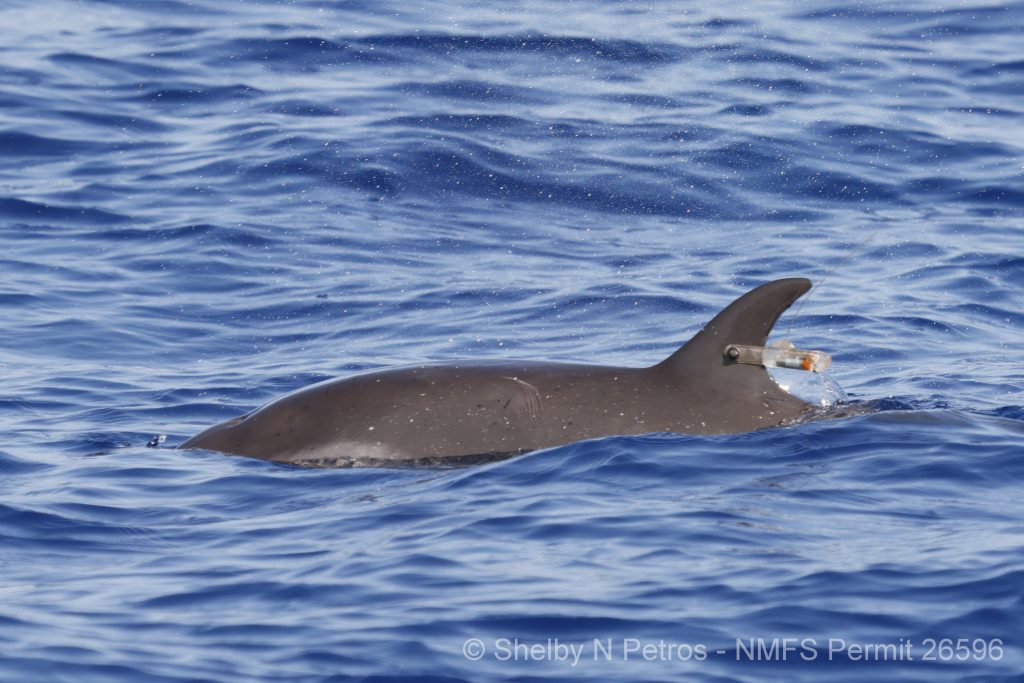
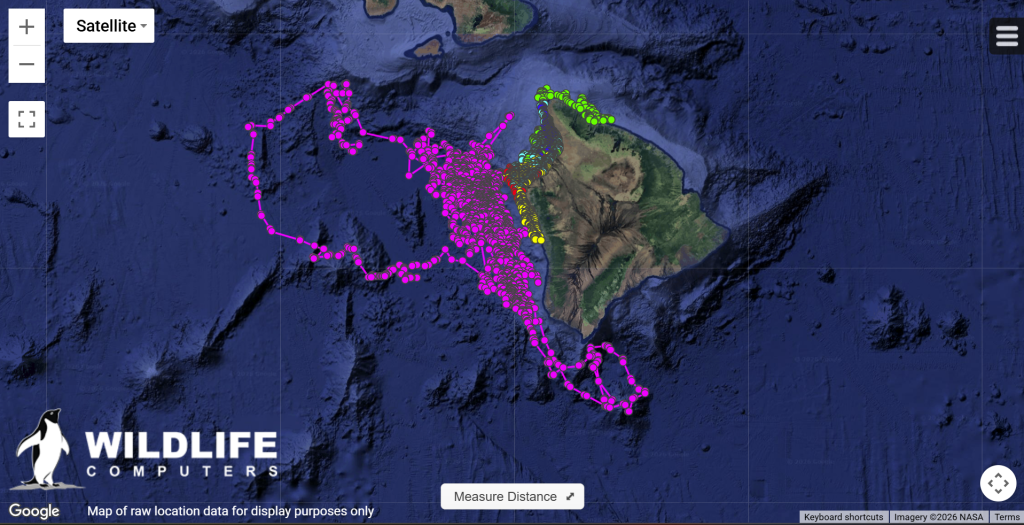
The map above shows the movements of the individuals we tagged this project. The pink points are a pantropical spotted dolphin, while the rest (closer to the island) are all spinner dolphins.
June 8 update
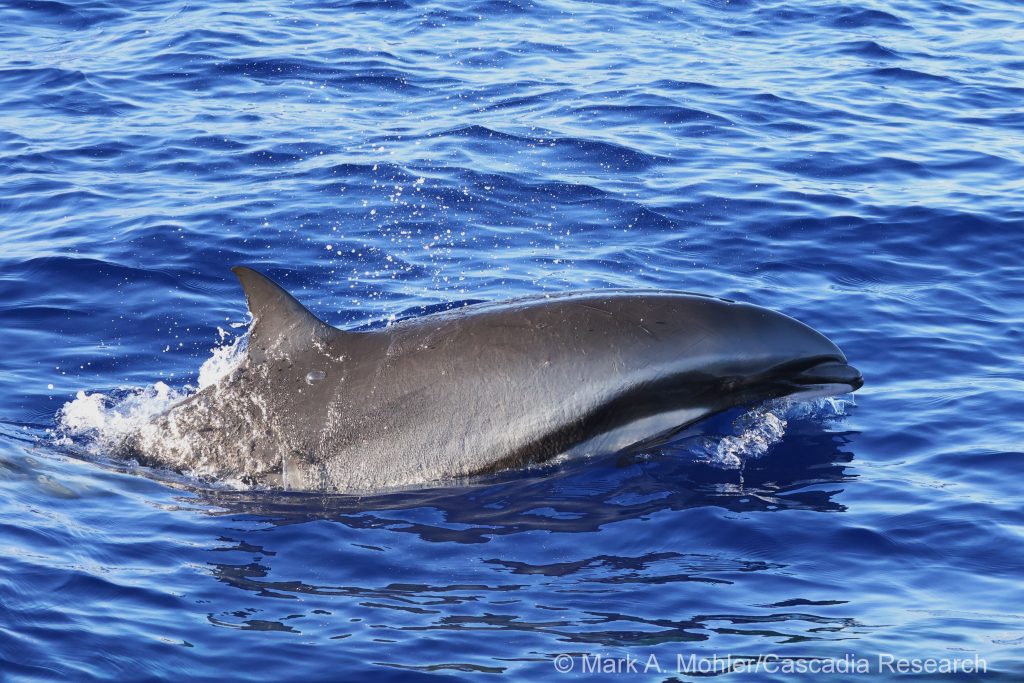
Today was our last day on the water for this project. Our first sighting of the day was a very exciting one, with a mixed group of melon-headed whales and Fraser's dolphins. Fraser's dolphins are very rare around the islands - this is only our 12th sighting of this species since our study began in 1999! Normally, Fraser's dolphins avoid boats, but this group was very interested in our boat and we were able to get good photos (including of this adult male) of many individuals in the group.
Fraser's dolphins are sexually dimorphic, with the adult males having a taller, more triangular dorsal fin and a black facial mask, while the females and juveniles have smaller, more falcate dorsal fins and more subtle pigmentation patterns. Most of our sightings of groups of this species have been associated with melon-headed whales.
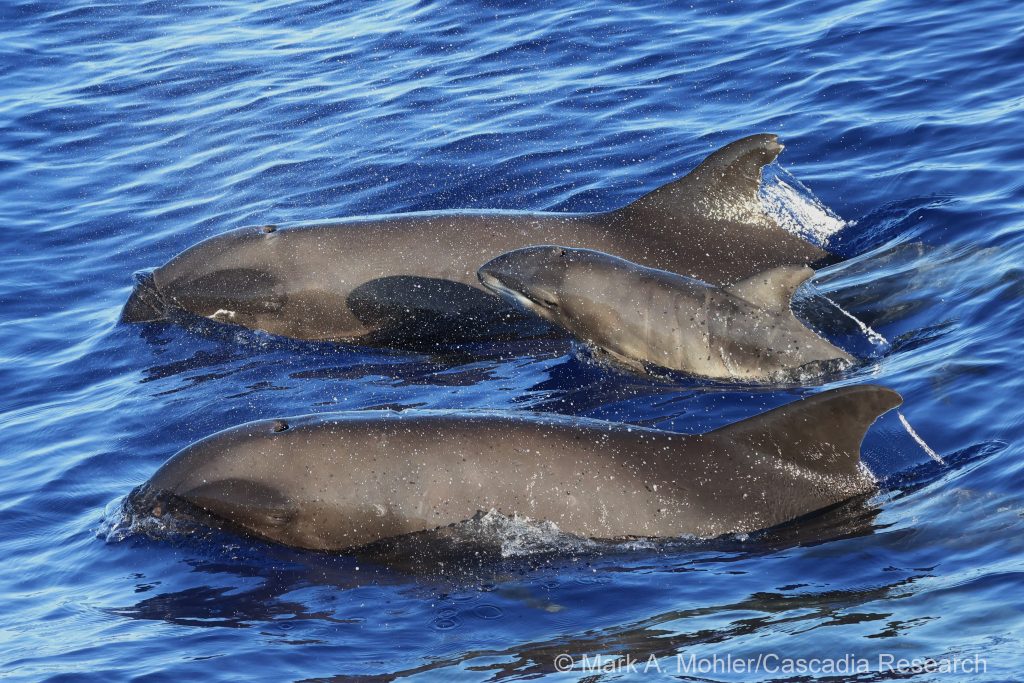
We encountered melon-headed whales on both of our last two days, and in both cases newborn calves were present. Melon-headed whales have the largest average group sizes of any whale or dolphin in Hawaiian waters, and our groups this trip were no exception - an estimated 340 individuals on June 7th and 180 on June 8th. If you want to learn more about melon-headed whales in Hawaiian waters check out our web page on this species.
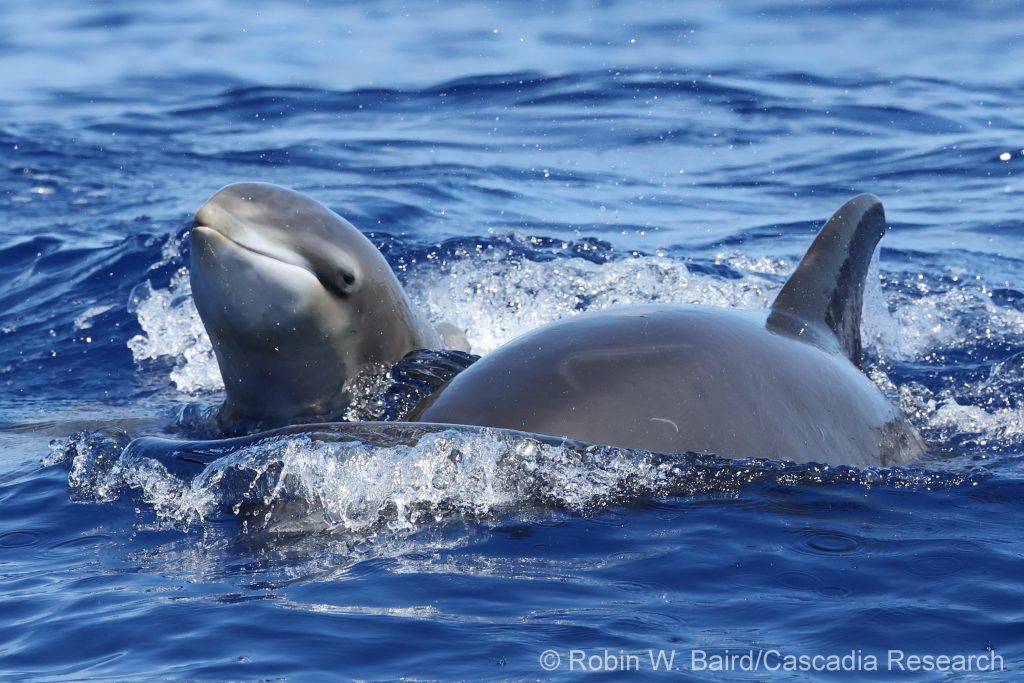
There are two recognized populations of melon-headed whales in Hawaiian waters, a small "Kohala resident stock", which inhabits shallow-water around Kohala, off the north end of Hawai'i Island, and a much larger Hawaiian Islands stock, which ranges offshore and among the islands and spends the majority of their time in deep water. The groups we encountered were both in deep water, so were presumably from the Hawaiian Islands stock.
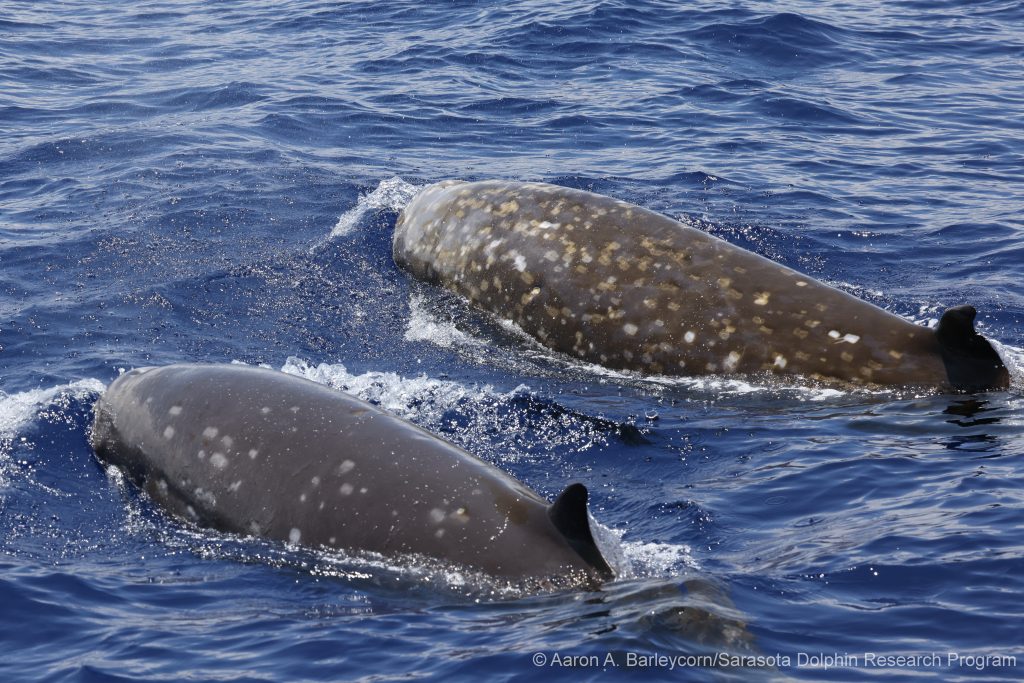
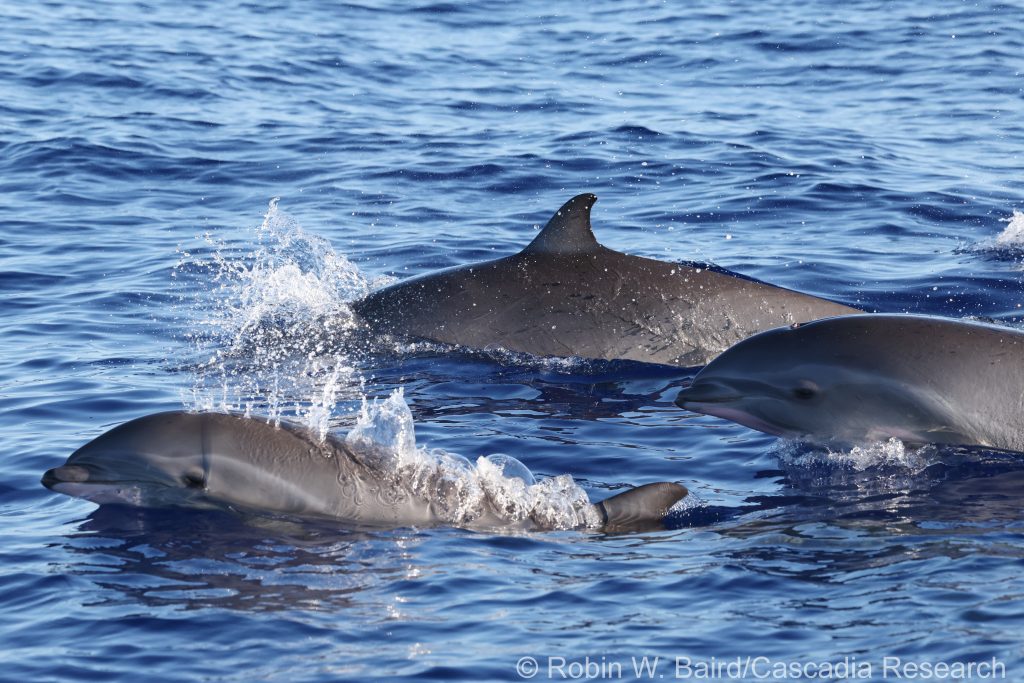
We also encountered two different groups of goose-beaked whales (also known as Ziphius or Cuvier's beaked whales). Goose-beaked whales accumulate white oval scars from cookie-cutter shark bites throughout their lives, and individuals can be identified by these scarring patterns, as well as by notches or nicks in their dorsal fins. The individual in the back is an older adult female, evident by the number of cookie-cutter scars and the lack of linear scars, which are characteristic of adult males. The individual in the foreground is a subadult, with far fewer scars. There is a small resident population of goose-beaked whales off Hawai'i Island, and both individuals are likely part of this population. If you want to learn more about goose-beaked whales, check out our web page on this species.
June 6 update
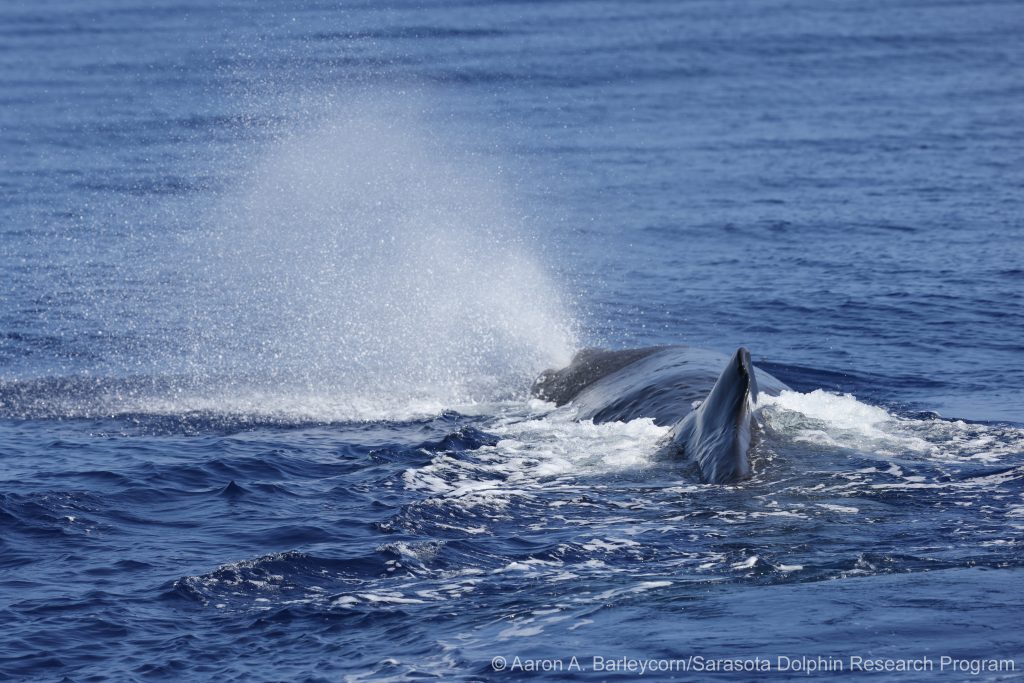
Today we encountered our ninth species of cetacean for the trip, sperm whales! Based on our previous satellite tagging of sperm whales in Hawaiian waters they appear to be part of a broadly-ranging central tropical Pacific population, with individuals passing by the islands.
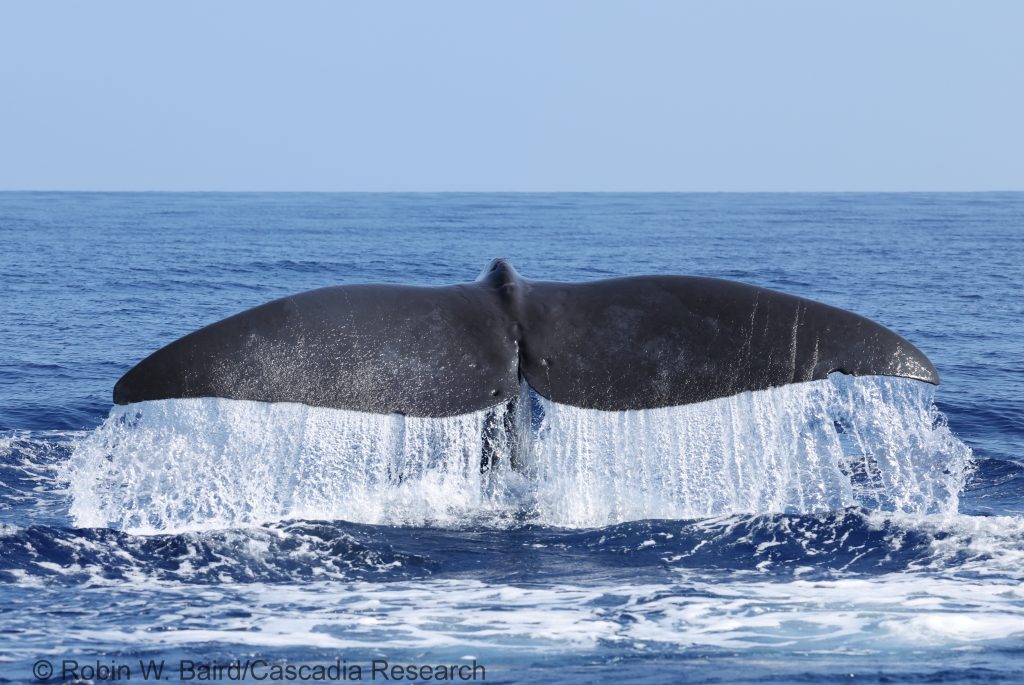
Sperm whales are individually identified based on the notches along the trailing edge of their flukes, so we position ourselves behind the whales and wait for them to dive to get ID photos (note - this is not an ID photo, but we did get one a few seconds later!).
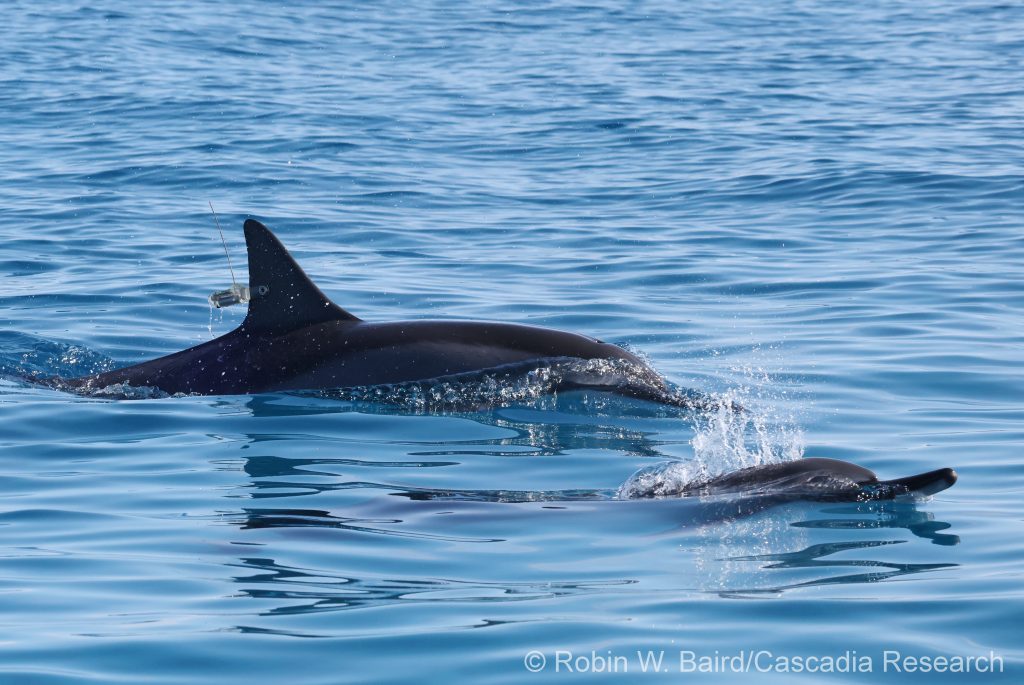
Over the last few days we also deployed finmount satellite-linked tags on two more spinner dolphins, with one of the tags also recording dive behavior. We've also encountered more short-finned pilot whales, bottlenose dolphins, and rough-toothed dolphins.
https://youtu.be/jtBgCz_Ka6U
This video shows a tagging of an adult male spinner dolphin on June 4th. Normally when tagged dolphins shows a startle reaction, but this individual showed little reaction and remained close to the boat after tagging.
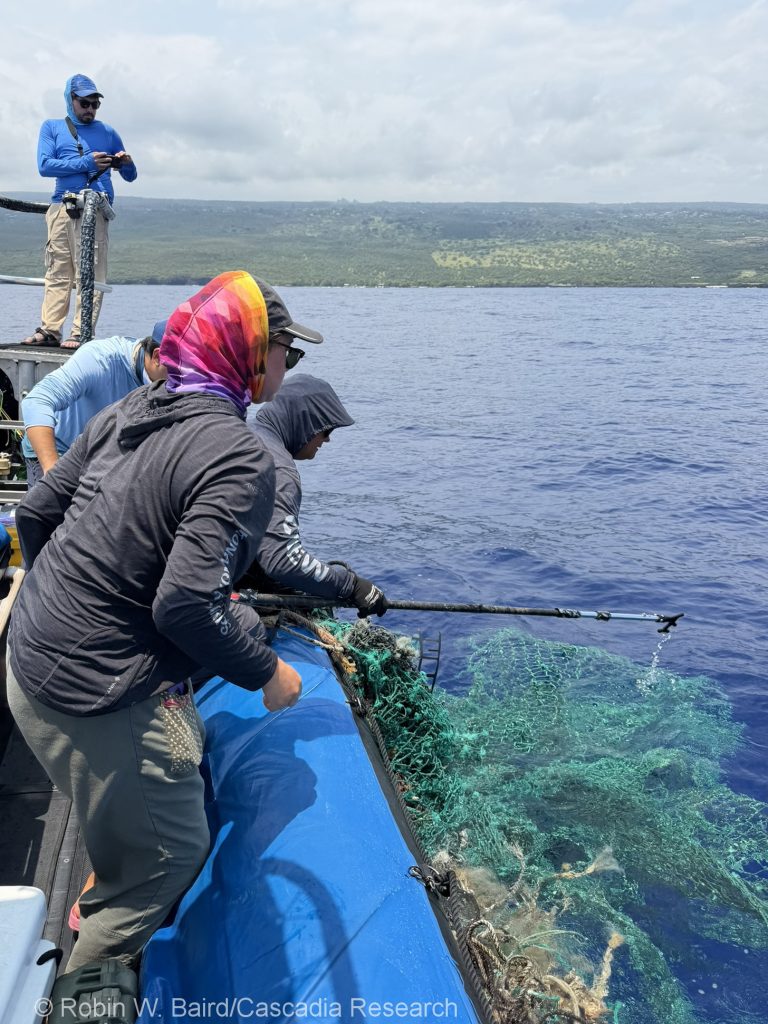
Marine debris is often an entanglement risk to marine mammals, seabirds, sharks, and fish, and if it'll easily fit in the boat we remove netting and lines out of the water for disposal on land. This trip we've pulled netting out of the water almost every day on the water.
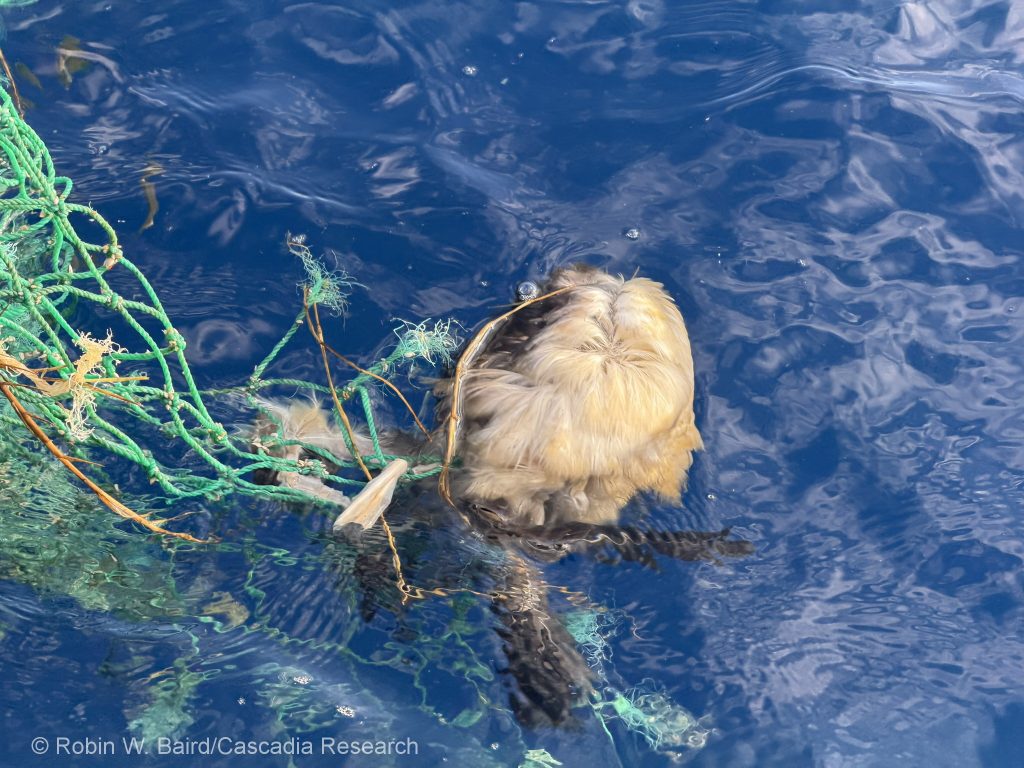
On June 4th we pulled out a smaller piece of netting with two dead entangled Wedge-tailed Shearwaters, the first time we have found birds entangled in marine debris.
June 2 update
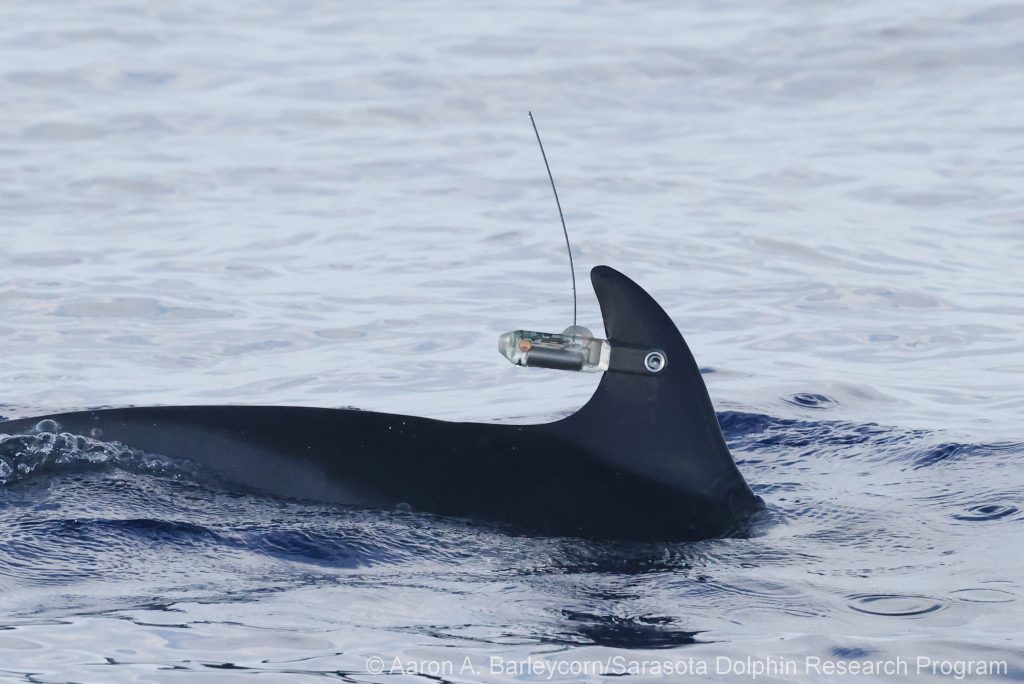
On our 4th day on the water we deployed our 4th satellite-linked tag, this time on a pantropical spotted dolphin. This is the 14th satellite-linked tag we've deployed on this species (the fifth off Hawai'i Island), and only the second finmount tag (the last was last November and it lasted 73 days). This tag is a SPLASH tag, that in addition to providing location information also provides dive behavior (the duration and depth of all dives over 30 m in depth). While we published a paper on diving behavior of spotted dolphins in Hawai'i in 2001 (pdf copy here), we haven't been able to collect a lot of dive data since, so are excited to see what information comes in from this tag.
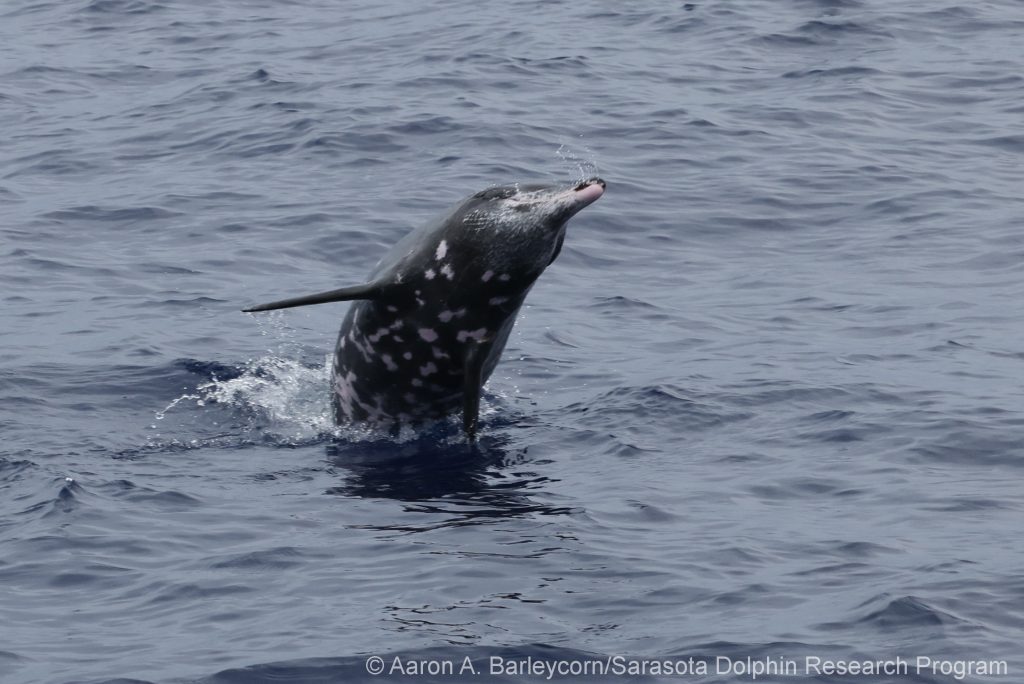
We also encountered two groups of rough-toothed dolphins. The individual above is an older individual, indicated by all the scars on the belly - these scars are caused by cookie-cutter shark bites, and in this species scars heal a different color than the background skin color.
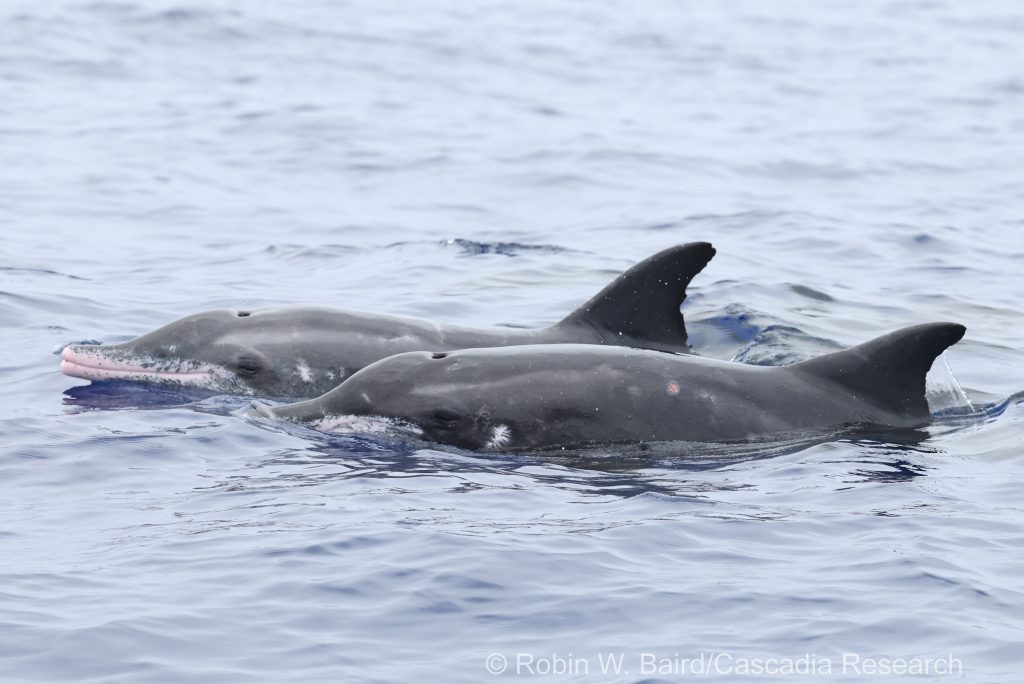
These two rough-toothed dolphins were first photo-identified off this island in the same group in April 2009, and they were seen together again in December 2009 and April 2012. In addition to notches and nicks on the dorsal fin, the pigmentation patterns of rough-toothed dolphins are permanent and individually distinct, so can also be used to identify individuals even when they have no notches on the fins. There is a resident population of rough-toothed dolphins off this island (our first paper on them was in 2008 if you want to learn more), but we haven't been able to keep our photo-ID catalog up to date, and there is lots still to learn about this population. We were able to obtain ID photos of almost 50 individuals from the two groups today.
June 1 update
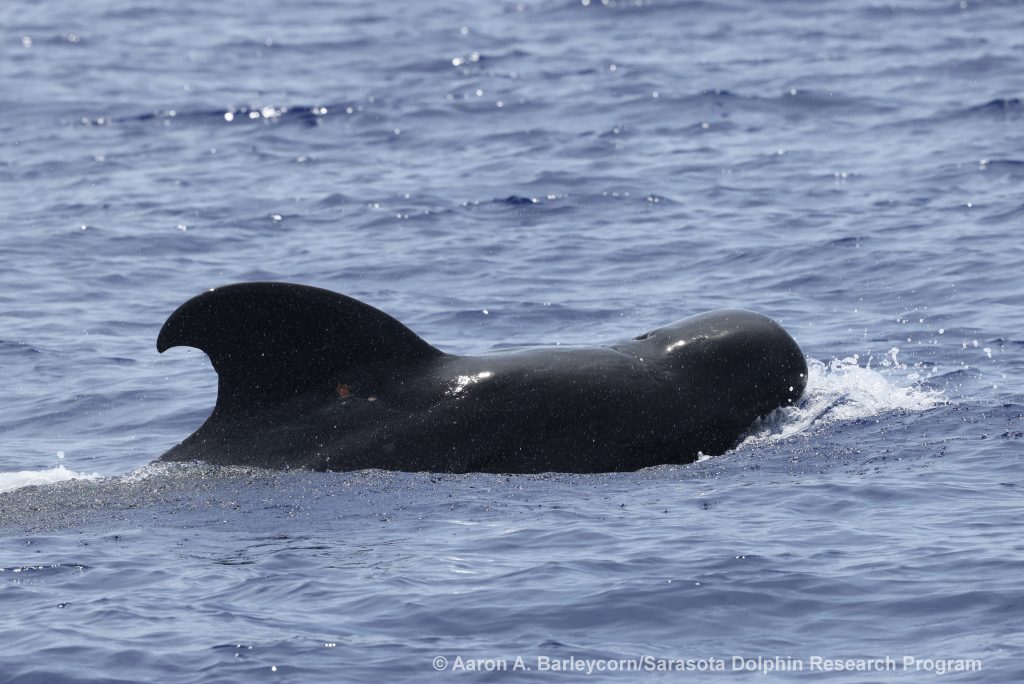
The last couple of days have been quite productive. We've tagged a third spinner dolphin (in a separate group from the other two), we've encountered both bottlenose dolphins and several groups of short-finned pilot whales (including a lone adult male, pictured above), obtained individual ID photos of a number of individuals, and recorded a lot of interesting seabirds.
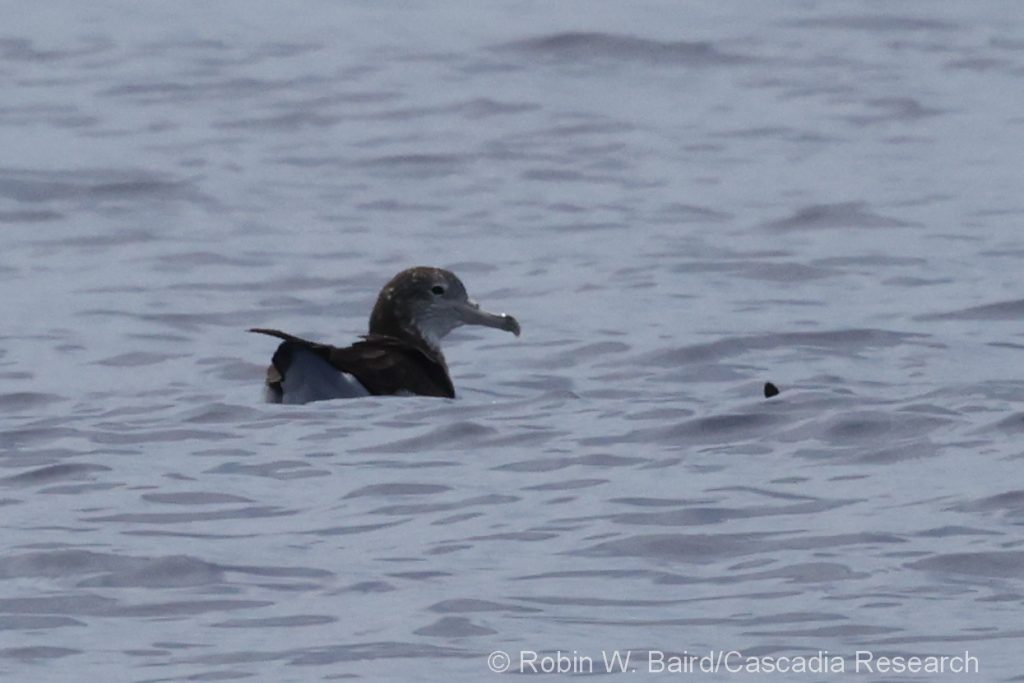
By far the most unusual seabird sighting of the trip was a Streaked Shearwater (photo above) - this is a species normally found only in the western Pacific, and this was our first ever documentation of one in Hawaiian waters. If you want to learn more about check out the eBird account for this species.
May 30 update
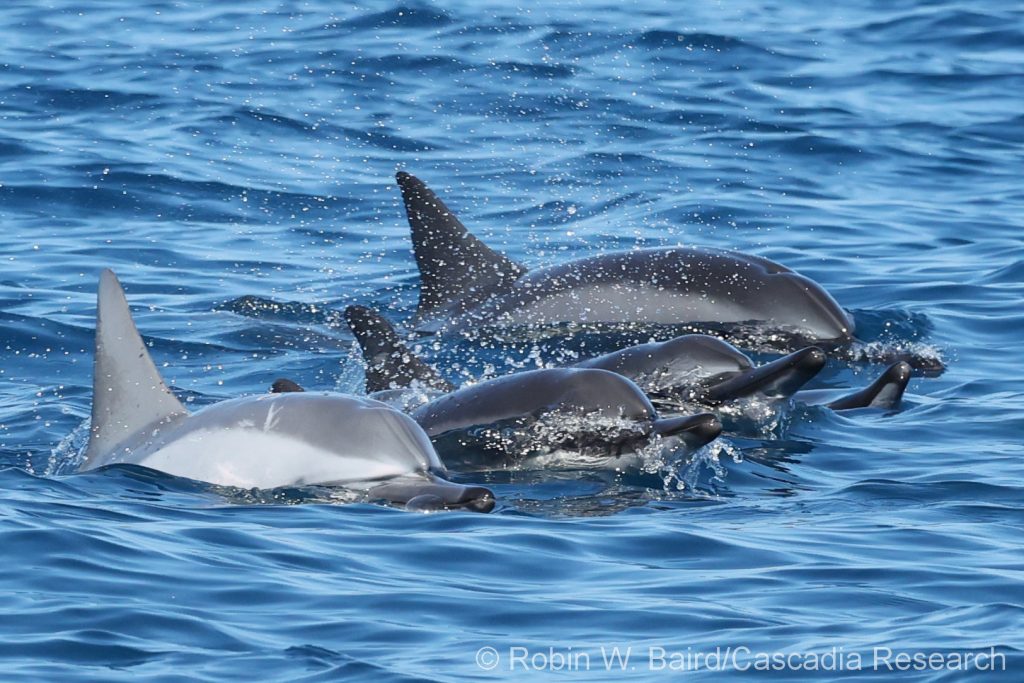
Today was the first day on the water. We encountered three different groups of spinner dolphins, and one group of bottlenose dolphins. Both species have populations that are resident to the island (with separate island-associated populations around the other islands). During one of the encounters we documented a leucistic (a genetic condition resulting in loss of pigmentation) adult.
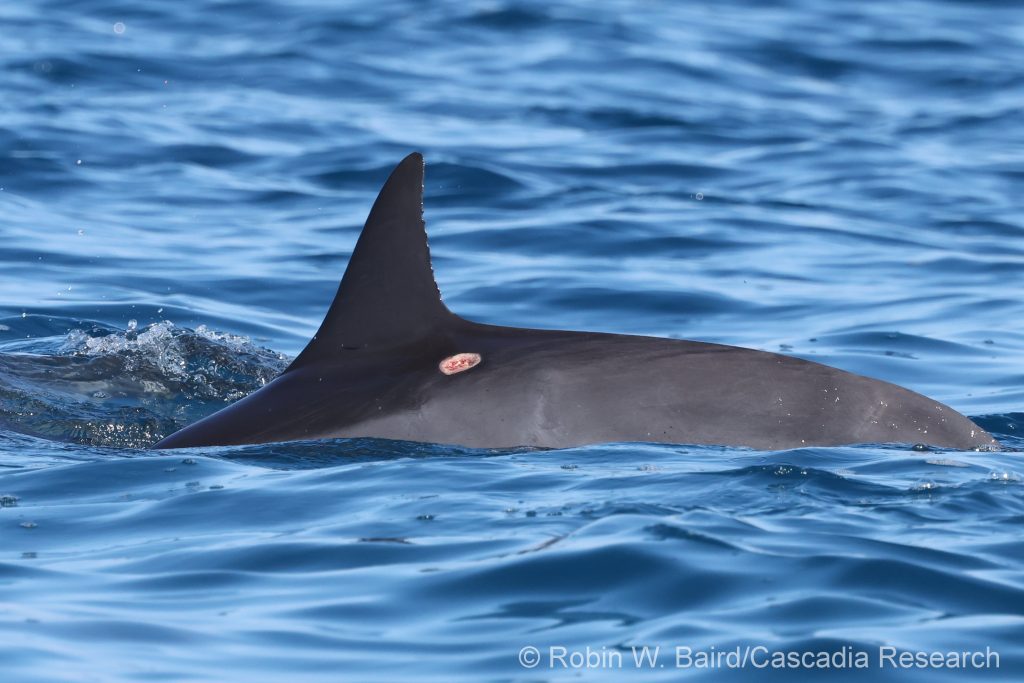
While spinner dolphins generally spend their days in shallow near-shore waters, at night they head offshore where they encounter cookie-cutter sharks, which come inshore and up to the surface at night - the dolphin above has a very fresh cookie-cutter shark bite wound below the fin. Usually these bite wounds heal well, but occasionally such wounds on the belly, particularly on young animals, can result in death.
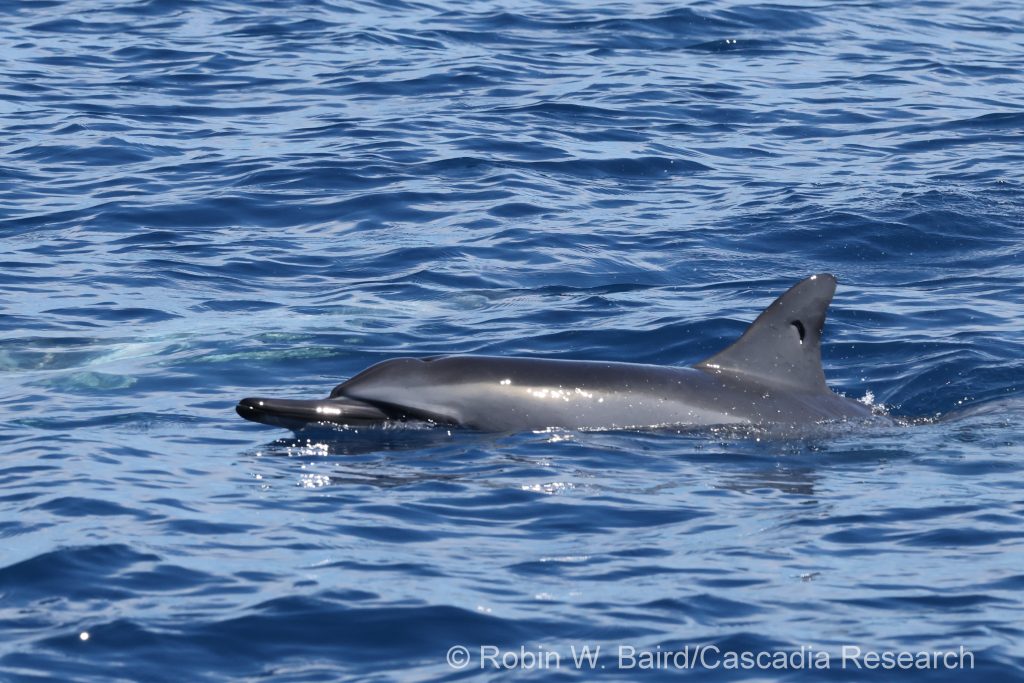
The spinner dolphin above has a healed cookie-cutter shark bite wound that penetrated through the dorsal fin, but which did not remove the normal "cookie" shaped plug of tissue.
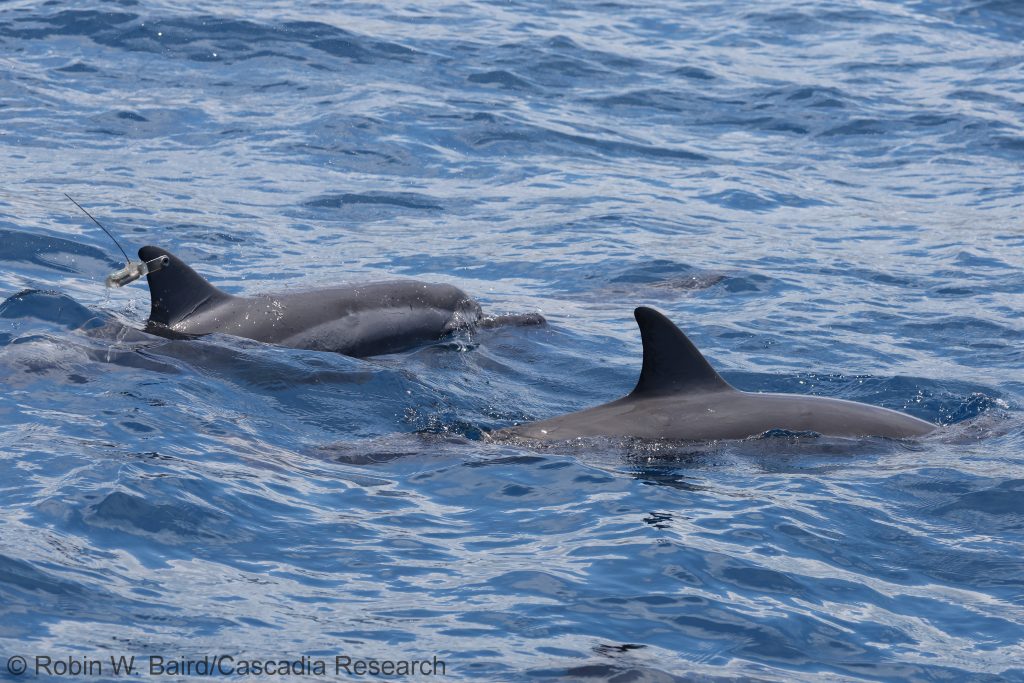
While we always like getting photos, our primary goal with our spinner dolphin encounters was to deploy finmount satellite tags to study their movements and behavior, and we had a very successful day. We deployed tags on individuals in two different groups, one SPLASH10 tag (the records diving behavior and provides location data), and one SPOT-435 tag (that provides location data). The advantage of the SPOT-435 tag is that it has a better battery and we can have the tag transmitting 24 hours a day, providing a detailed track of the movements of the individual. This is the first time that satellite-linked tags have been deployed on spinner dolphins off this island (last year we tagged spinners off O'ahu and Lāna‘i). We are excited to see where our tagged dolphins go over the next few weeks.