Blue whales (Balaenoptera musculus) are the largest animals ever known to have lived on Earth. The Northeast Pacific is home to one of the world’s most studied blue whale populations, and Cascadia Research Collective has been a leader in understanding their distribution, behavior, and long-term movements for more than 40 years.
Size & Appearance
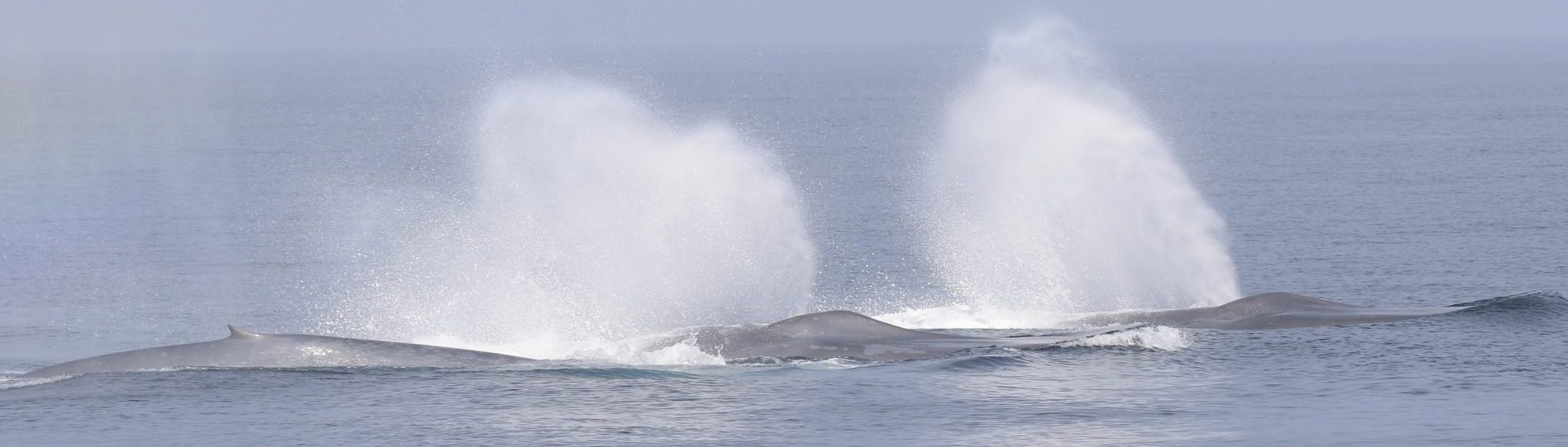
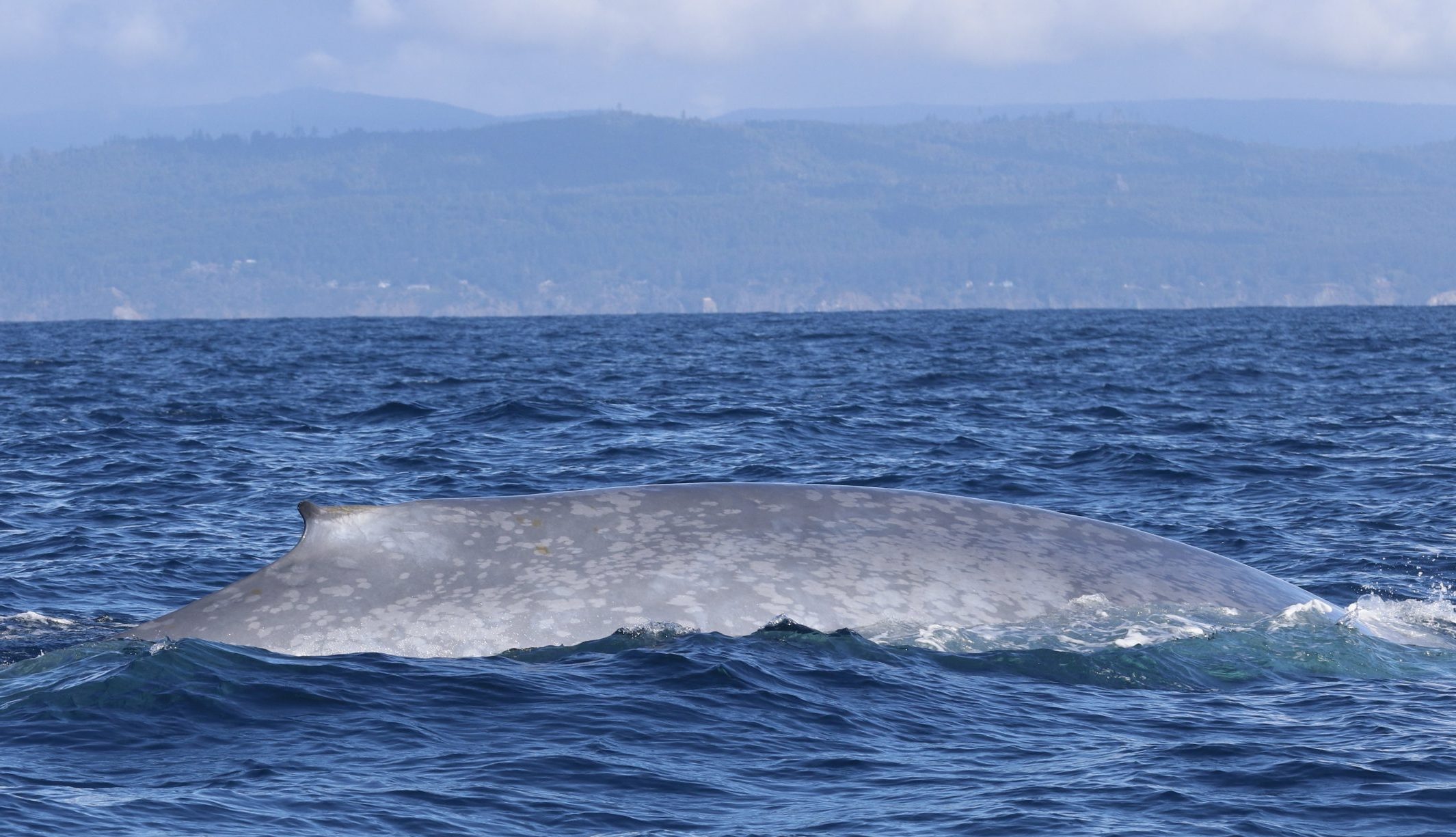
Blue whales can reach 80 – 100 feet and weigh up to 150 – 180 tons. Their long, slender bodies appear blue-gray underwater, and their tall, cone-shaped blow, often 30 feet high, is one of the most distinctive cues for identifying them at sea.
Life Span
Blue whales can live 70 – 90+ years, with some individuals estimated to surpass a century.
Diet & Feeding
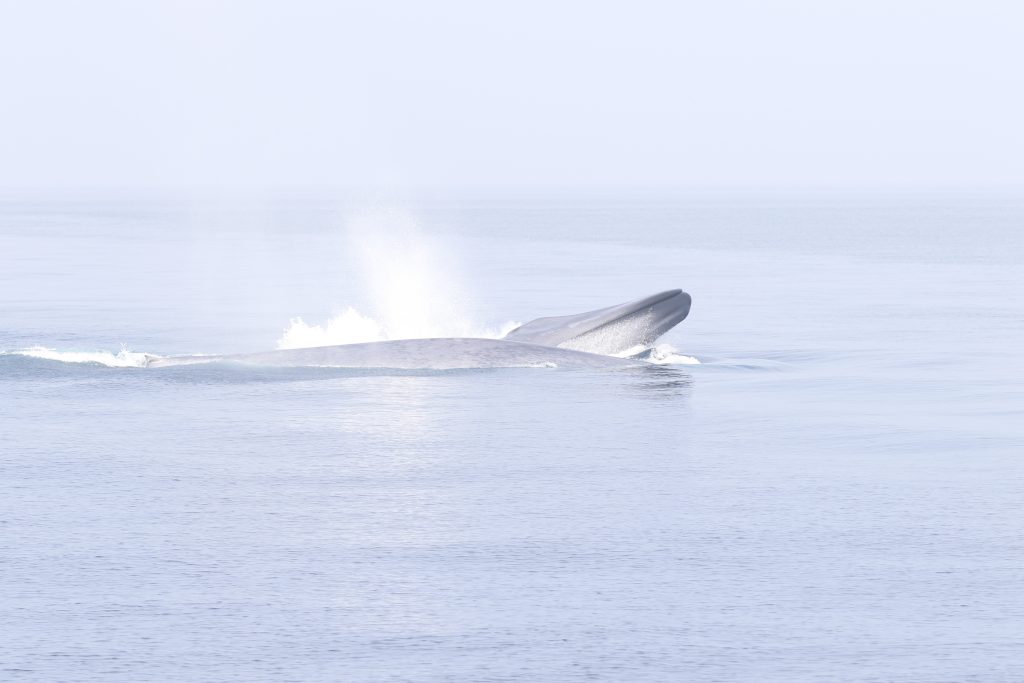
Despite their enormous size, blue whales feed almost exclusively on krill, consuming several tons per day during peak feeding seasons. They lunge through the water to engulf vast swarms of krill before filtering from the water using the baleen plates lining their upper jaw.
The Northeast Pacific Population
The Northeast Pacific population migrates seasonally between winter breeding areas in Mexico and Central America and summer/ fall feeding areas from California to British Columbia. Cascadia’s decades of photo-identification and tagging studies have revealed consistent feeding hotspots along the US West Coast, including the Southern California Bight, Monterey Bay through the Gulf of Farallon’s, and waters off Northern California/ Southern Oregon.
This population remains endangered, with worldwide blue whale numbers still far below pre-whaling levels.
Blue Whale Quick Facts
Scientific name: Balaenoptera musculus
Size: 80–100 ft (24–30 m)
Weight: Up to 150–180 tons
Life span: 70–90+ years
Population status: Endangered; still well below pre-whaling numbers
Where they occur: California Current System (California, Oregon, Washington, BC) Wintering areas off Mexico & Central America
Diet: Krill (can consume 4+ tons per day)
Feeding method: High-energy lunge feeding on dense krill swarms
Migration pattern: Flexible, prey-driven movements along the US West Coast. Winter/spring breeding areas farther south
Cascadia’s role: 40+ years of photo-ID, tagging, abundance studies, health assessments, and management-focused research
Migration Along the US West Coast
Blue whales generally appear off the US West Coast from May through November, following dense krill patches influenced by oceanographic conditions.
Their migration is less rigid than gray whales; instead of a single corridor, blue whales track productivity and prey distribution, making them sensitive to climate-driven ecosystem shifts.
Threats to Blue Whales
Blue whales face several significant conservation challenges:
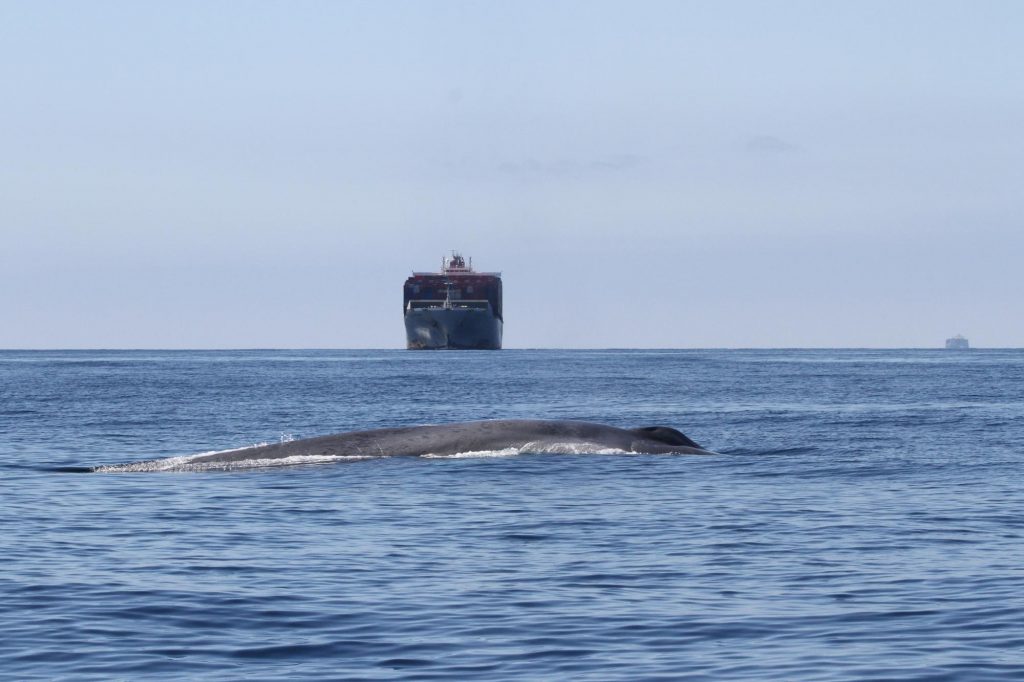
Ship strikes, particularly in busy shipping corridors
Entanglement in fishing gear
Changes in krill distribution driven by ocean warming and climate variability
Anthropogenic noise (shipping, military activities, seismic surveys)
Chemical contaminants and pollution
Historic population depletion from commercial whaling (still recovering)
Ongoing monitoring is essential to understand how blue whales are responding to rapidly changing ocean systems.
Cascadia’s Blue Whale Research
Cascadia Research Collective maintains one of the world’s most important long-term blue whale research programs, including:
Photo-ID catalog spanning thousands of individual blue whales
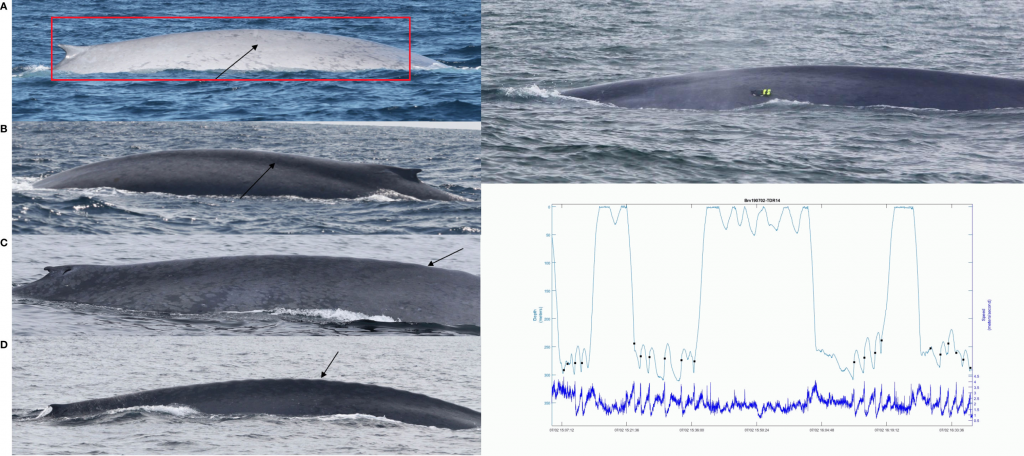
Archival tagging to study fine-scale behavior and migration
Cascadia’s data have directly informed regional management measures, including vessel speed restrictions and shipping-lane adjustments to reduce whale strikes. Click on the topics above to learn more about Cascadia’s diverse research.
Left panel is from Wachtendonk et al. (2022) showing body condition scoring. Upper right panel shows a suction-cup tag on the side of a blue whale. Lower right panel is a plot of the tagged blue whale's dive (light blue line), lunging for prey (black dots), and speed (dark blue line).
Watch the video below from our collaborators at Stanford University talk about new technology to record the heart rate of blue whales. Cascadia and Stanford have continued to advance this science with new tag design in 2025 with further testing planned for 2026.