Humpback whales (Megaptera novaeangliae) are one of the most recognizable and charismatic whales in the world. Their acrobatics, complex songs, and long migrations make them a favorite among whale watchers and an essential part of the marine ecosystem along the US West Coast. Cascadia Research Collective has been studying humpbacks for more than four decades, producing some of the most comprehensive data on their life histories, movements, and conservation needs.
Size & Appearance
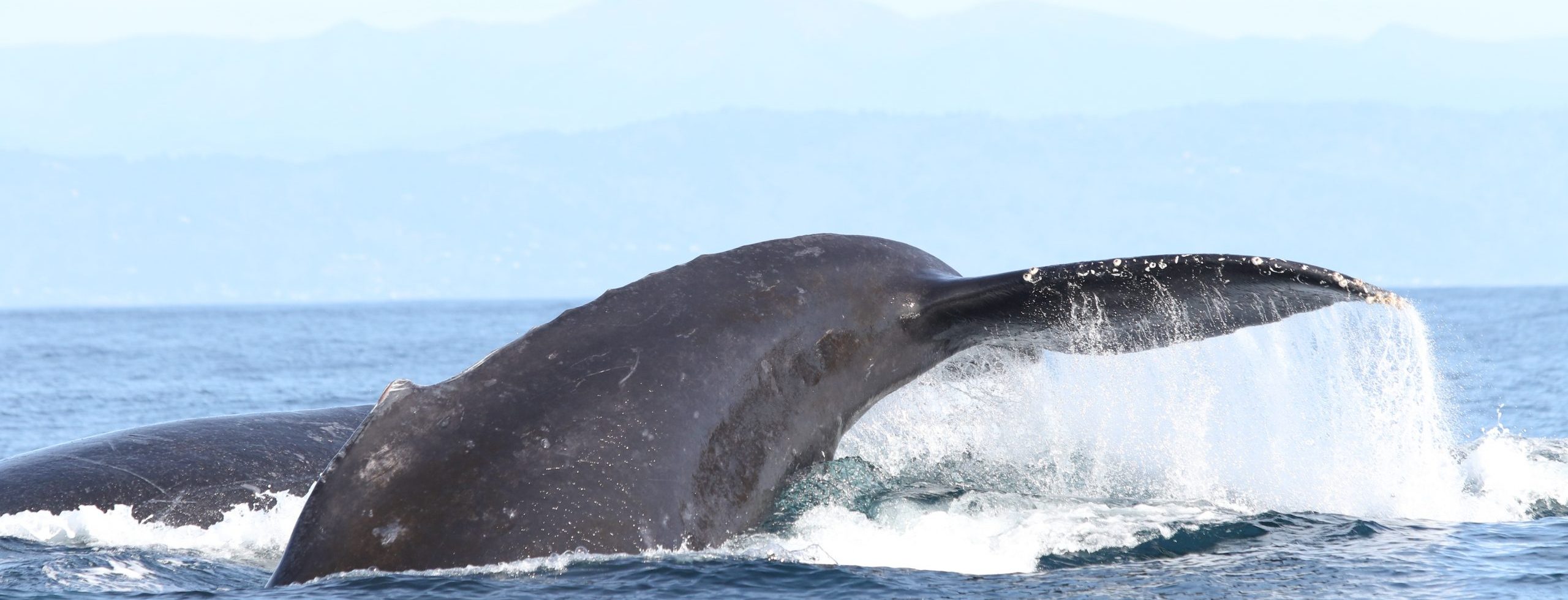
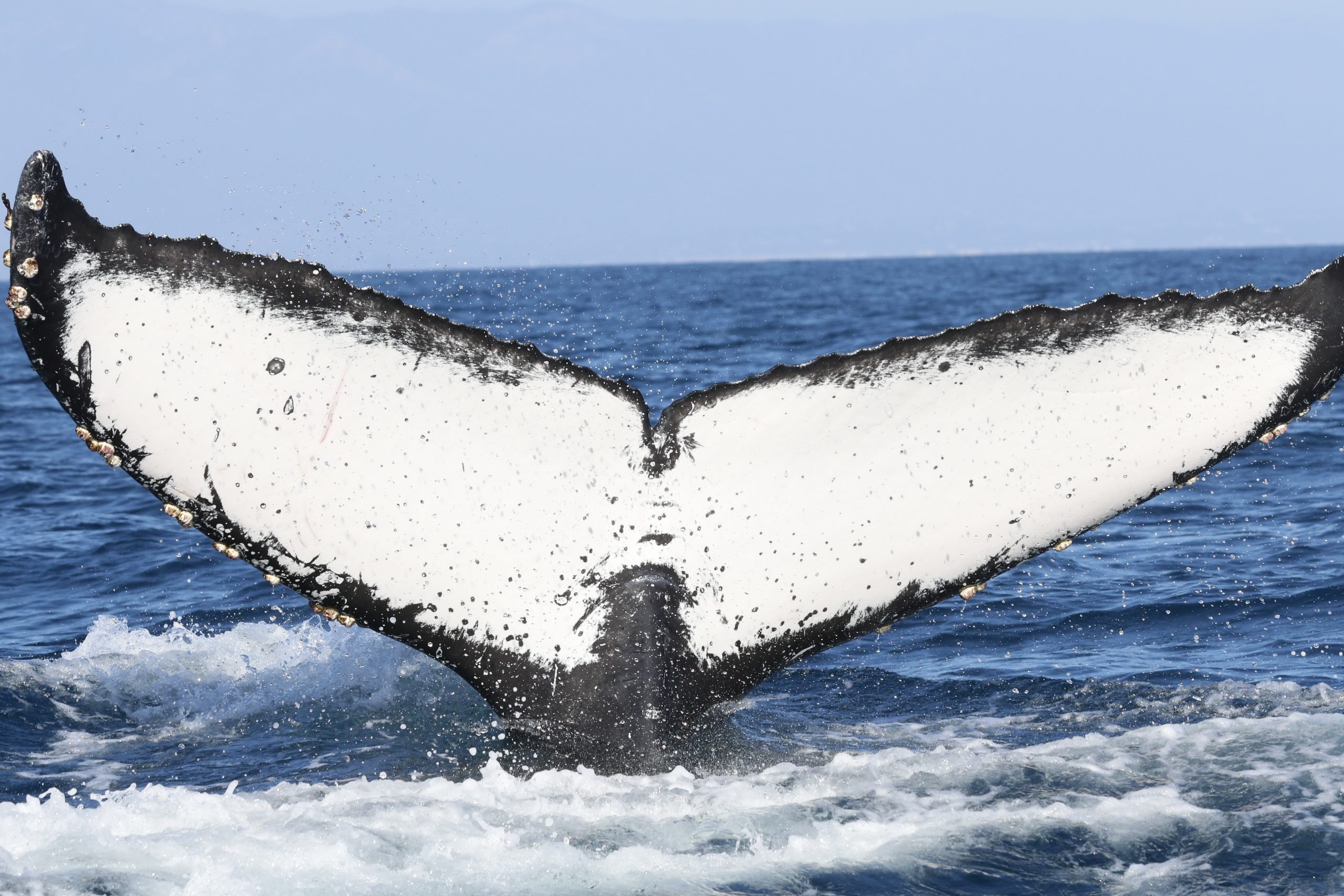
Humpbacks reach 40–50 feet in length and weigh up to 40 tons. They are easily identified by their long pectoral flippers, which are about one-third of their body length, their knobby head, and their uniquely patterned flukes (tails), which are used for individual photo-identification.
Life Span
Humpbacks are estimated to live 50 – 70 years. With photo-Id research starting in the 1970’s, we can use sighting length as a minimum age – the longest of which is slightly over 50 years. However, the age of the whales during their first encounter is not always known. An alternate method is counting the ear plug growth layer groups, like counting tree rings. This method was commonly used while collecting data on whaling ships, however, it is more difficult to collect when from a whale that die and wash ashore. The oldest whale based on counting ear plug growth layer groups was in their 90’s.
Diet & Feeding
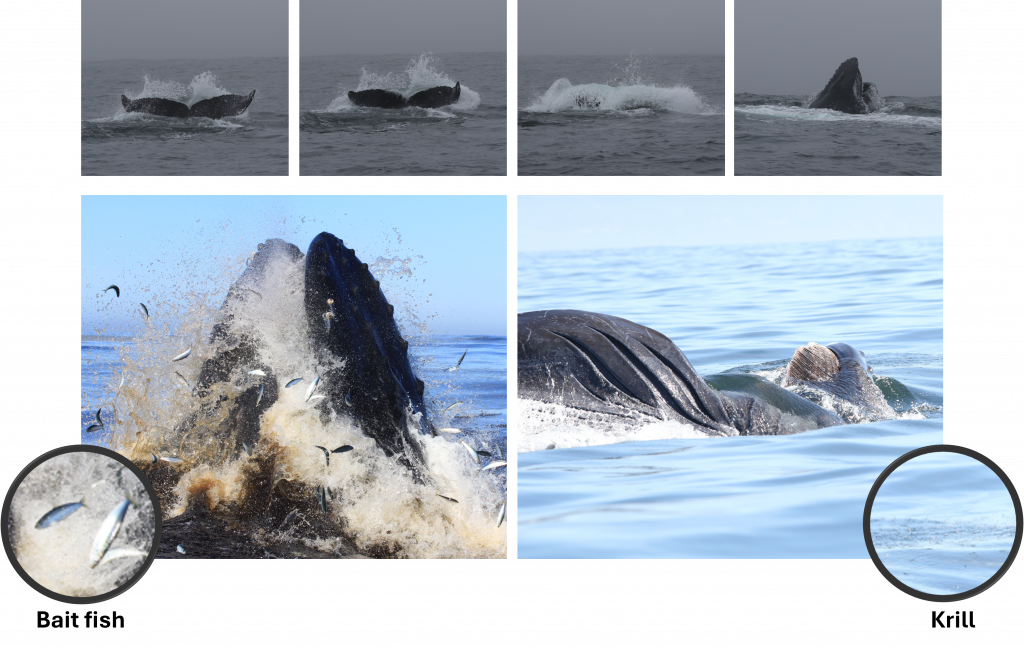
Humpbacks feed primarily on krill and small schooling fish (anchovies, sardines, herring, sand lance). They are known for highly coordinated, sometimes spectacular feeding methods:
Surface lunge feeding
Bubble-net feeding (solo and coordinated)
Flick feeding
Deep foraging throughout the water column
Their feeding behavior varies by region and prey availability.
The top row of images exhibits flick feeding behavior while feeding on krill. Bottom left is a humpback forcefully lunging through a school of bait fish. Bottom right is a humpback side lunging through a patch of krill.
Humpback Whale Quick Facts
Scientific name: Megaptera novaeangliae
Size: 40–50 ft (12–15 m)
Weight: Up to 40 tons
Life span: 50–70+ years
Population status: Varies by Distinct Population Segment; some endangered, some recovered
Where they occur: California, Oregon, Washington (feeding grounds) Mexico, Hawai‘i, Central America (breeding/calving grounds)
Main threats: Entanglement, vessel strikes, prey shifts, noise pollution
Cascadia’s role: 40+ years of photo-ID, tagging, health assessments, population analyses, and conservation-focused research
Migration Along the US West Coast
Humpbacks migrate thousands of miles each year:
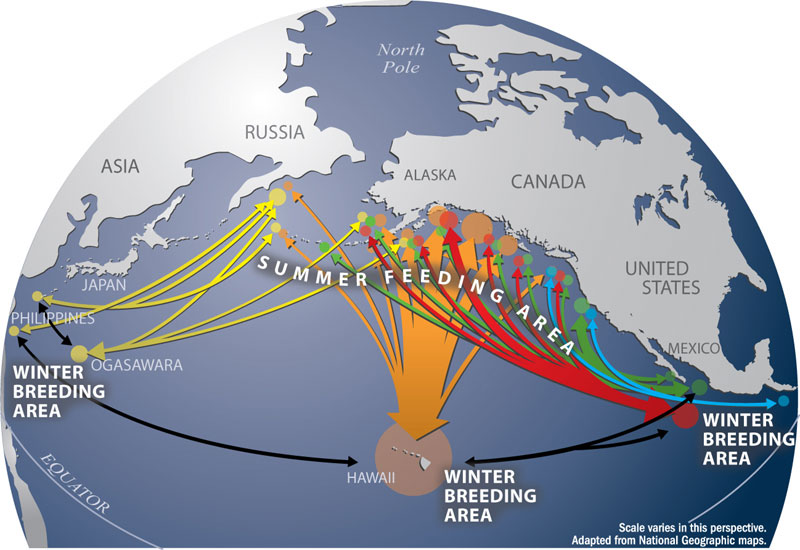
Summers and fall: Feeding in nutrient-rich waters ranging from California to the Artic
Winters: Traveling to warm breeding and calving areas in Mexico, Hawai‘i, and Central America
Their arrival along the West Coast varies by region and typically begins in late spring, with peak numbers during summer and early fall. Cascadia is studying migratory timing in relation to entanglement risk, and providing critical data to managers so they can reduce overlap between whales and fishing gear.
Graphic showing feeding and breeding areas in the North Pacific. Arrows indicate movement between locations, but not actual migration routes. https://sanctuaries.noaa.gov/news/features/0108_splash.html
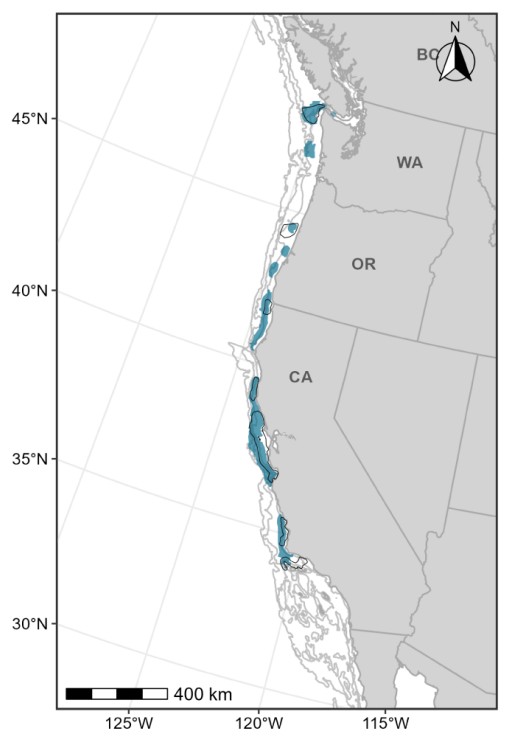
Core boundaries of Biologically Important areas for humpback whales along the US West Coast. Calambokidis et al., 2024.
Feeding Hotspots and Biologically Important Areas
Cascadia’s tagging and photographic data have identified key feeding areas and biologically important areas, including:
Monterey Bay
The Greater Farallones region
Point Arena and Northern California
Oregon coastal waters
Washington’s outer coast and inland waters (seasonally)
These hotspots shift within and between seasons depending on krill and fish availability, oceanography, and climate conditions. Yearly shifts in prey distribution led to increase risk of entanglement when nearshore prey is more plentiful – causing increased overlap between foraging whales and fishing effort.
Breeding Grounds & Distinct Populations Segments (DPS) in the North Pacific
Humpbacks exhibit maternal site fidelity to both the breeding and feeding grounds. Typically, whales will return to the same breeding ground where they were born. To improve the ability to protect and monitor humpback whale populations, managers have group the feeding grounds into three Distinct Population Segments. These segments including:
Central America DPS (endangered)
Mexico DPS (threatened)
Hawai‘i DPS (of least concern)
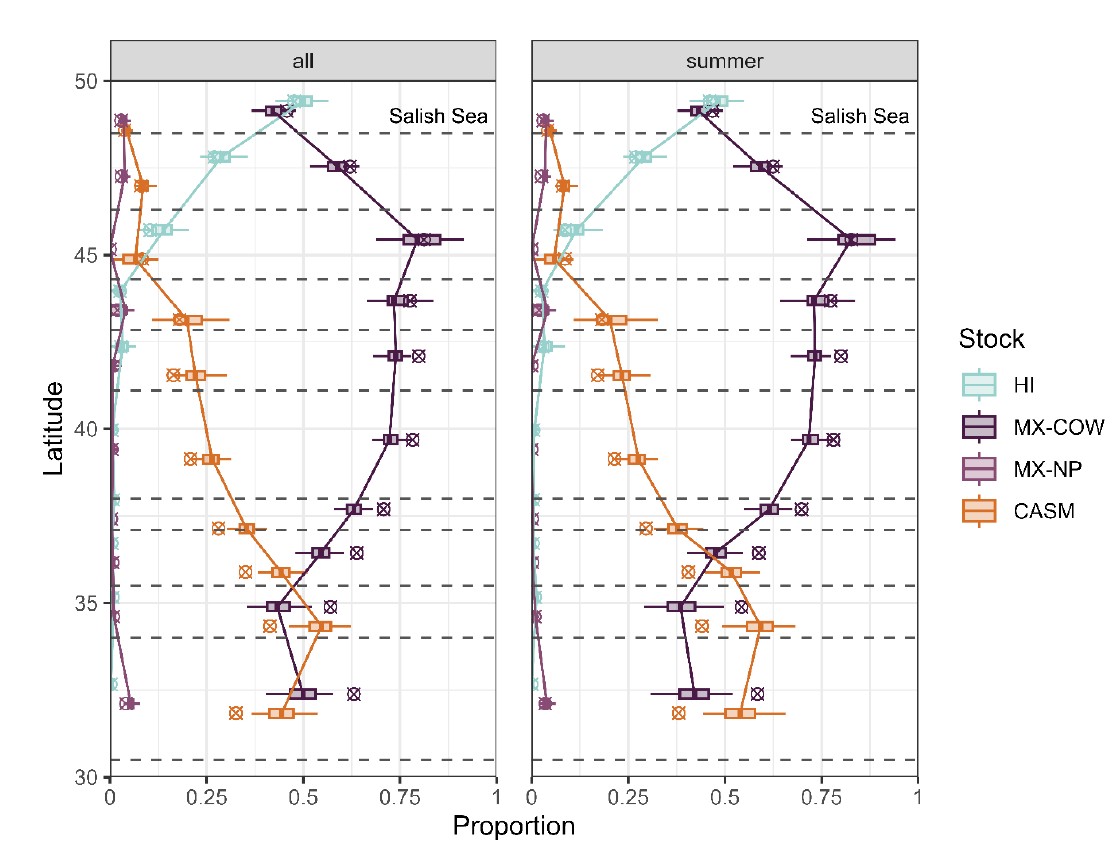
Each DPS has different conservation status as they appear to be recovering from whaling at different rates. All three DPS feed and migrate between along the US West Coast, but their distribution varies by region. A higher proportion of whales that breed in Central America feed in Southern and Central California compared to Washington. At the same time, whales that breed in Hawaii are more likely to feed in Washington compared to Southern California.
Cascadia’s long-term datasets have been a primary source of information used to define these populations and assess their trends.
Graphic from Curtis et al., 2025 exhibiting the proportion of humpback whales assigned to each DPS (Mexico DPS split into a California, Oregon, Washington (COW) subset and British Columbia north (NP)) along the US West Coast ranging from Washington State at the top to Southern California at the bottom.
Threats to Humpback Whales
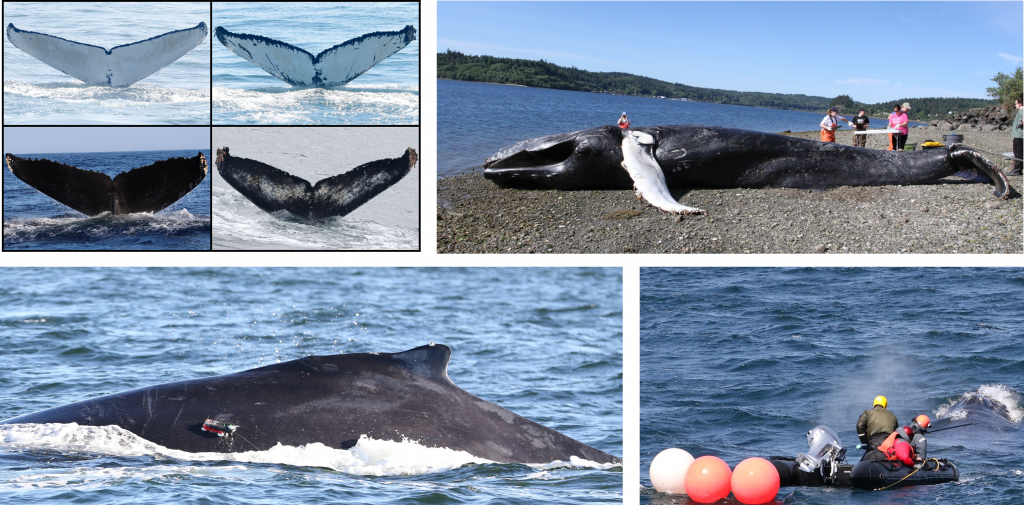
Humpback whales have to navigate anthropogenic risks like ship strikes and entanglements. The fluke images here are of survivors that bare the scars from natural predators (orca attacks) as well as ship strikes and entanglements.
Humpbacks face a variety of natural and human-caused threats, including:
Entanglement in fishing gear
Vessel strikes
Shifts in prey availability due to climate variability
Marine heatwaves altering fish and krill distributions
Noise from vessels, industry, and military activities
Harmful algal blooms and disease
Pollution and contaminants
Ongoing monitoring is essential as environmental conditions shift rapidly along the US West Coast.
Cascadia’s Humpback Whale Research
Cascadia Research Collective’s data have directly informed the federal listing of DPSs, critical habitat decisions, fishery management, and shipping-lane modifications. Cascadia maintains one of the most extensive humpback whale research programs in the world, including:
Decades-long photo-ID catalogs representing thousands of individuals
Biologging to study fine-scale movement, feeding behavior, and habitat use
Population trend analyses, abundance estimates, and DPS assessments
Stranding response, necropsies, and health evaluations
Vessel-strike risk assessment
Entanglement response and research working towards prevention
Prey and ecosystem studies linking whale distribution to krill and schooling fish