13 April 2026 Cascadia Research Collective
Since 1 April 2026, 6 dead gray whales were found in Washington, bringing the total so far this year to 9. This represents the highest annual number of strandings by this time of year that we have ever recorded. This level of early season mortality, combined with sightings of multiple live gray whales in poor nutritional condition in unusual areas around Puget Sound and changes in behavior patterns in the “Sounders” group of whales, suggests that gray whales continue to face significant challenges and we may be facing another year of elevated mortality.
Gray whale strandings in Washington typically occur from April through June, when whales are migrating along the Washington Coast to their feeding grounds in the Bering Sea. Our average number of annual gray whale strandings in normal years is 5, but since the onset of the Unusual Mortality Event (UME) in 2019, we have been averaging over 15 per year. Our peak number of strandings usually occurs in May, which is why this number of dead whales so early in the stranding season is concerning. In those whales where examination was possible, malnutrition continues to play a major role in the death of these whales.
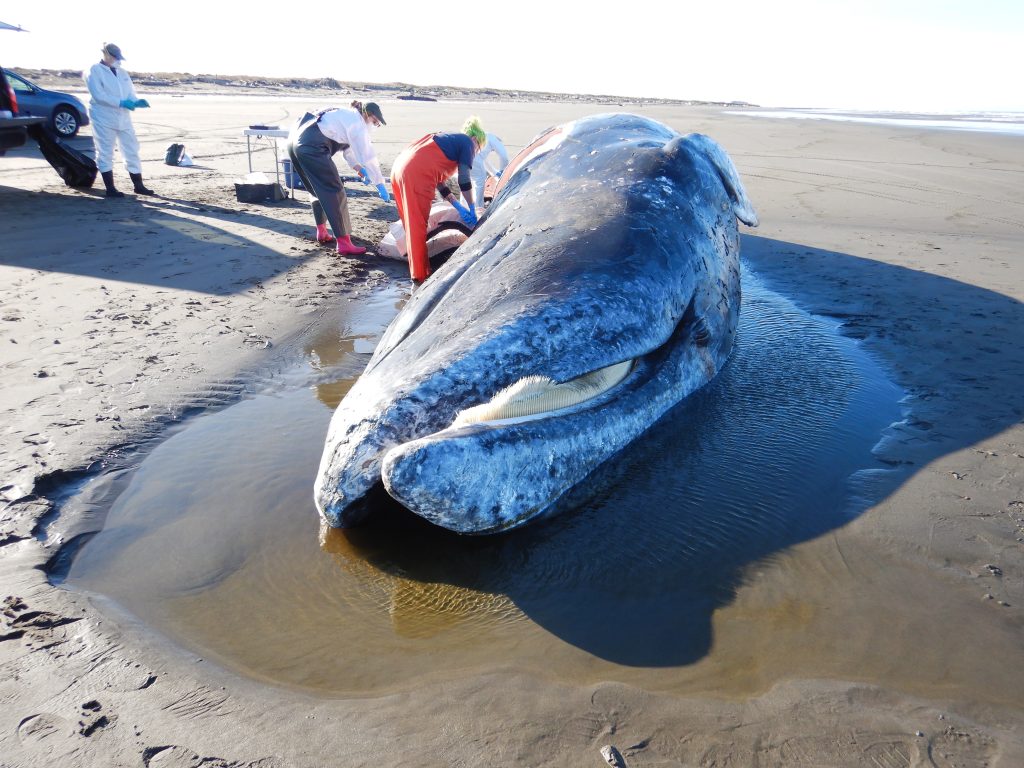
Strandings of gray whales in Washington in 2026 through 12 April 2026
Date | Location | Details |
3/2/2026 | Offshore, central WA coast | Male, floating, unable to examine |
3/21/2026 | Olympic National Park | Male, emaciated |
3/28/2026 | Taholah | Male, advanced decomposition |
4/1/2026-4/4/2026 | Willapa River | Gender pending genetic analysis, malnourished, out of habitat |
4/3/2026 | Ocean Shores | Male, malnourished, blunt force trauma |
4/3/2026 | Ocean Shores | Female, malnourished. Known individual, identified in summer 2025 in Grays Harbor. |
4/6/2026 | Anacortes | Examination pending |
4/11/2026 | Moclips | Male, examination pending |
| 4/12/2026 | Offshore, southern WA coast | Floating, unable to examine |
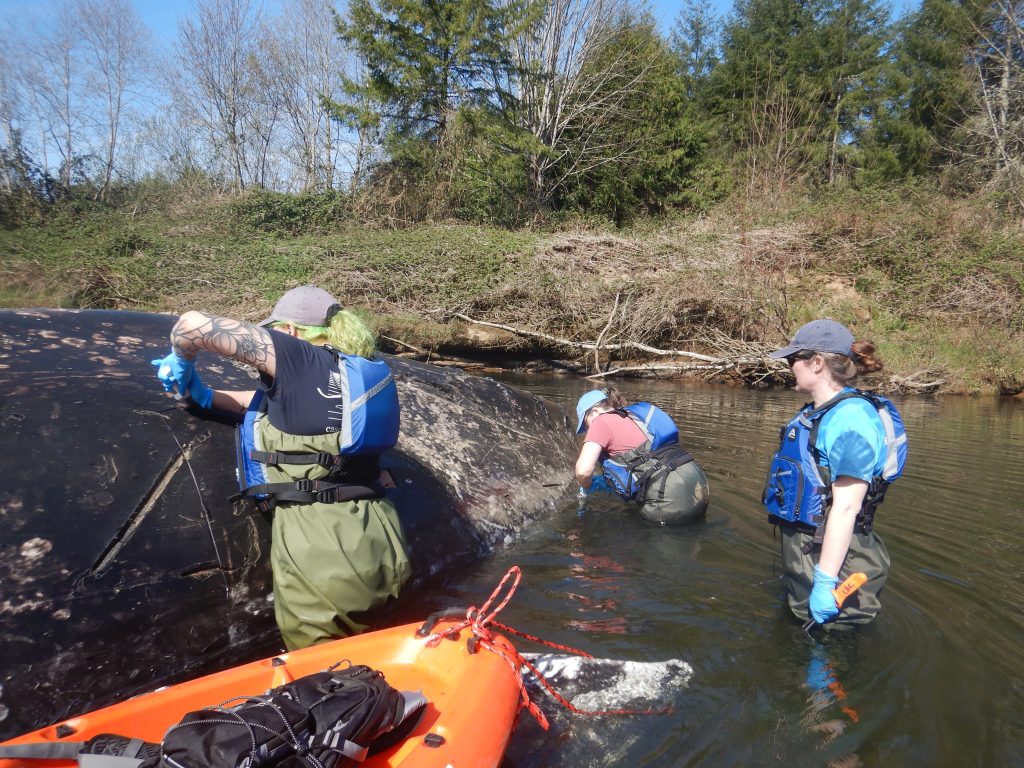
In addition to stranded whales, we have been monitoring several live gray whales in poor nutritional condition in unusual areas around the state. While some of these whales may be able to find their way to productive feeding areas (like the “Sounders”), others, like the whale that recently swam up the Willapa River, are not so lucky. These malnourished whales trying to feed in unusual areas are likely debilitated and may also be more vulnerable to traumatic events like ship strikes, entanglements, and killer whale attacks.
The “Sounders”, a small group of gray whales that discovered the productive ghost shrimp beds around Whidbey and Camano Islands in the early 1990s, have fared better overall during this UME, but we have seen changes in how they have utilized the Puget Sound feeding areas over the last few years. In the past, these whales would arrive in the Puget Sound in March to feed for a couple of months before continuing to the Bering Sea and would not return until the following spring. However, for the past few years some of these individuals have returned as early as December (5 in December 2025) and have stayed throughout the winter and spring, foregoing their migration to the breeding grounds in Mexico and prioritizing a known area of available food over reproduction. This is especially worrying given the already low numbers of calves that have been recorded on the breeding grounds.
https://www.eopugetsound.org/article/gray-whales-salish-seaDo not try to approach whales closely in boats and avoid transiting at high speed in areas of whale concentrations, such as in Possession Sound. Please support efforts to reduce contributions climate change which appears responsible for the dramatic ecosystem changes in the Arctic. Report strandings of any marine mammal species to the West Coast Marine Mammal Stranding Network hotline at 1-866-767-6114 and whale sightings to our partners at Orca Network (https://www.orcanetwork.org/report-sightings).
You can learn more about Washington’s gray whales by reading this article written by Cascadia staff and recently published in the Encyclopedia of Puget Sound.